Showing posts with label marathon. Show all posts

Welcome and Congratulations!

Welcome to your resource for everything you need to know to successfully complete your first marathon and congratulations on making the decision to do something only a select group people will ever accomplish in their lives!

The latest statistics show that only about one out of every 10,000,000 people will run a marathon. That puts you in a pretty elite group of people and you should be proud of that fact. Running a marathon is a big accomplishment and it requires a big commitment and the rewards mentally, emotionally, physically and even spiritually are immense!

Let's get this show on the road(no pun intended)! First, we'll take a quick look at what you can expect as you begin training and then of course what you can expect on race day! We'll call it the overview, sort of a snapshot of what's to come in the next weeks and months of your life as a marathoner. After that we'll get into more specifics and match you up with the training plan that best matches your current level of fitness and your lifestyle.

We'll be delivering this training through daily lessons, videos, a training schedule and even provide you with the opportunity to email the coach with your questions.

Without any further adieu, let's introduce the coach and get this party started!

Gear: Beyond Shoes

Running is great because you lace up your shoes and head out the door. It's really that simply and yet as we look at preparing for and running long distances, the demands we put on ourselves does require a little bit of gear to make it through those particularly long runs.


How much gear? That's a personal choice and a question you'll need to answer for yourself. My goal here is to provide you with a look at what's out there so you can make an educated decision on what's right for you.


One of the biggest factors in long distance running is hydration. While you may not need to carry lots of fluids with you on your short days, certainly there is a need for some way of getting liquids on those runs that take you out on the road for over an hour.


There are loads of solutions and so I've tried to bring you a good selection depending on your approach to solving the problem of keeping hydrated.


If you simply decide that you will stop and buy a water or sports drink when you are out running then all you really need to worry about is where to put your money. Over the years I've used several different shoe or running wallets with a lot of success. This simple design attaches over the laces on the top of your shoe and provides a convenient place for money, Id, keys, etc. I'm currently using the Nike Running Wallet, which features a hard plastic clip that locks in through the laces and is made of an expandable material. It keeps what I need securely in place and no matter how much my foot sweats, everything stays dry inside. I have used a more basic design in the past which features a velcro strap to attach to the laces. It is a little larger than the Nike, but it does not expand which means, whatever fits, fits and that's it. While hunting for these images I did find several other neoprene shoe wallets of a similar design to Nike for a couple of bucks less. Just do a google search for shoe wallets and you'll find them. For me I'm sticking with what I've got because I know it works for me!


If you're not in to stopping for a couple of minutes to buy a water there is always the basic water bottle. Again they range from "just a bottle" to much more elaborate. I've tried both ways. The problem for me with carrying just a bottle is it's awkward and inconvenient.


Currently, when I'm running a mid distance where I need some fluid and I don't feel like stopping mid run to buy some I carry a Nathan Sports Quickdraw Plus water bottle. It comes with a carrying strap that also features a storage pouch for keys, Id, etc. The one I have also includes a clip on the cap that easily clips to my waste so I don't have to hold onto it once it's empty. The carrying strap makes this particular design easier to bring along as I don't really have to grip the bottle once I slide my hand into the strap.


If you don't mind hanging on to the bottle the whole time you are running you can find water bottles just about anywhere from sporting goods store to discount store to drug stores. Most water bottles are somewhere in the 20 to 22 oz. size and at the recommended 6 oz. per half hour of running you should be fine for quite some time with them.


There is also another solution for this range of running the waste pack. Most of these "belts" will include a holster for one large bottle or several holsters for multiple small bottles. An obvious advantage here is the fact that you can carry water plus some form of electrolyte drink as well.


I have to say that I do not own one of these because I have never been comfortable with a heavy load around my waist (except for my belly of course). A lot of runners seem to swear by them. The most popular seem to be the ones made by Fuel Belt. I see them in every marathon and almost everyday when I run.


Once you start to get into the really long distances your options change. Of course you can just carry more money or you can take a look at hydration packs. I own a Camelbak and am pretty happy with it when I need it. Remember one thing, the bigger the pack the more weight you'll be adding and the more adjusting you have to do to get used to it. The picture to the right is the newest version of the one I have. It's a 50 oz. version. That should be plenty of water for your long runs and although I paid a little more for mine a couple of years ago, you can find them online today for under $30. Some of the other big manufacturers are of course Nathan Sports and Hydrapak. Once again, I can't really recommend one brand over the other, I just know that what I'm using works for me.


Urban running can present its' own share of problems and obstacles. For me that means, as much as I'd like to be disconnected from everything by not carrying my cell phone or keys or Id, it's not really an option. Unless I'm going for a quick 3 or 4 miles, I always like to carry my cell and enough money for cab fare if I hit some nasty sidewalk and twist something. You might say I'm setting myself up for disaster (predicting the future) but, I look at it as being prepared, especially since I would have been royally screwed if I didn't have my cell phone with me when I had my heart attack!


And so as I said, unless it's only 3 or 4, I'm prepared like a boyscout every time I head out the door. My cell phone doesn't fit in my shoe wallet. It does fit in my hydration pack, but what about those in between distances?


That's where we introduce the fanny pack or the waist pack. Once again, I turned to Nathan Sports for mine, but they're not the only game in town. Nike, Asics, Brooks, Roadrunner Sports and more, all make decent waist packs. The best for me is the kind with a neoprene waistband. Over the long run it's just more comfortable.


In a marathon like Los Angeles or Long Beach, I don't worry about fluids because they have a ton of stations set up along the course. What I am concerned with is the quick energy when I'm running out of gas. My waist pack will carry a supply of gel shots to help me through a marathon, along with my cell phone, Id, keys, money, etc. I've actually managed on a few occasions to even carry my digital camera in there as well as all the other stuff. I don't recommend that too often though.


Beyond the types of gear I've talked about so far there are several different types of performance monitoring devices designed to help you track and improve your training based on feedback. They range from the simple pedometer to the highly advanced combination GPS heart rate monitoring systems.


We'll take a look at some of them now.

If I was going to recommend one extra piece of gear in particular for monitoring and improving your overall performance it would be a heart rate monitor. While your number one goal for completing a marathon is just plan to be able to say you did it, I would like to think that somewhere in the back of your mind you like the idea of improving your overall health and fitness.


In order to consistently improve your aerobic fitness. You must improve your cardiovascular system. As a general rule, when exercising aerobically, the most consistent improvements in aerobic fitness come when you are exercising in the range of 60 to 90% of your maximum heart rate. Your exact target heart rate depends on several factors including your level of fitness.


Training outside of that target heart rate range will either show little or no benefit, or can put the individual at risk. A heart rate monitor will allow you instant feedback which should allow you to stay in the zone where the most gains can be made.


As with the other gear we've discussed, there are several manufacturers. I own a Polar S625X which is combined with a foot pod to track distance as well. Others include Garmin, Timex, Reebok, Acumen, Oregon Scientific and a whole slew more. Prices vary dramatically depending on features and I found some online for as little as $35.


This is a piece of equipment that takes a little getting used to because you are wearing not only the wrist receiver but also a chest band which reads your heart rate and transmits it.


Available features range from simple heart rate monitoring to time, distance,and even speed monitoring as some of the units are combined with a GPS unit.


One of the most motivating pieces of equipment I own is my Garmin Forerunner 205 wrist GPS unit. Had I been patient enough when I bought it I would have held out for the 305 which includes a heart rate monitor, but it's still pretty cool. This device is not a necessity and yet it is great to have. Most of these GPS based units will allow you to track your workouts and then upload them to your computer and for those of you wanting to share your workouts with the world, you can then upload them to running blogs and other websites where you can share your favorite workouts with everyone. It's pretty cool watching your miles click up there on your computer as you download workouts. The only drawback for me and the reason I don't wear it more often is the bulkiness versus my regular Nike training watch. I'm not into bulky accessories when I run if I can at all avoid them. So the heart rate monitor or the training sports watch tend to win out over the GPS. Timex does also have a GPS unit that works similarly, but the GPS unit attaches to your waist or an armband. Pretty trick and they do work!


There you have it. A summary of the gear. I did not discuss apparel or the ever popular media systems on the market. I address the right or wrong clothes to wear here.

As for the media thing, I guess I'm just one of those guys who likes to keep running pure and experience my surroundings when I run.

If the Shoe Fits

"No doubt a brain and some shoes are essential for marathon success, although if it comes down to a choice, pick the shoes. More people finish marathons with no brains than with no shoes." - Don Kardong


The beauty of running is how liberating and refreshing it is!

That and the fact that you don't have to have a huge bank account to fund your gear supply. That being said, if there is one area you really don't want to compromise in, it's in the shoes. Get the right match the first time and your feet, knees, hips, back and pretty much every other part of your body will reward you with pain-free running. Get it wrong and you could find yourself cheering for your fellow marathon runners from the sidelines.

So where do you begin?

There are several well-known manufacturers of great running shoes today. I'm not going to mention them specifically here, because brand is less important to me in this selection than the right match. I do have a couple of personal preferences which I will be happy to share with you if you ask, but each of us is a little different and so what I wear may not be the right thing for you.

Before you go running off to the shoe store to buy the first pair of really good looking shoes you can find, there are some things to consider. Let's start with your bio mechanics. Don't worry, I'm not going to get all technical here, in fact, I really couldn't if I wanted to. I'll explain it as simply as I understand it.

Bio mechanics when it comes to running is basically, how your foot strikes the ground initially and then how it rolls as you move forward in your stride.

There are three basic categories that most runners fit into. They are:


  1. Supinators

  2. Neutral

  3. Pronators

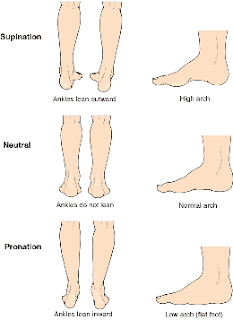
What exactly does that mean? Let's look at a diagram to see how this works out.


You need to have a friend or family member watch you walk or run from behind to really tell what's going on here. If you are a Supinator, that means that as your foot strikes the ground your ankles tend to roll to the outside. You will probably depending on the degree of supination, tend to be a little pigeon-toed (walking with your toes point inward) when you walk. Neutral is pretty much exactly as described and your ankles tend to remain fairly upright when striking the ground. Pronators will then tend to have an ankle that rolls inward when they strike the ground. This can often be recognized by when you're walking as a duck walk (toes point outwards).

As I said have someone watch you walk barefoot from behind. Make sure they also see you run because sometimes a tendency doesn't show up until more force, like that involved in running is added.

The reason this is important is that shoes today are designed with all different kinds of support in the soles, mid soles and uppers to help runners be most efficient depending on their individual bio mechanics. Get this little bit of knowledge right and it will be one big thing that won't be distracting you during your training.

Another factor to consider is your weight. If you are quite a bit over-weight as you begin running (and you need to be honest), you may tend to pound the pavement a little more. Shoe manufacturers also offer different levels of cushioning in their shoes to help accommodate for this heavy pounding.

And then there is your running technique or form. Watch a hundred people run and you'll see a hundred variations in the way we run. The three most common are;

  1. Heel-strikers
  2. Forefoot runners
  3. Mid foot runners

A heel striker does just exactly that. They strike the ground with their heel and then roll the foot forward. Look at a picture of a heel striker in stride and you'll see their front leg extended almost straight, heel towards the ground and toes pointed to the sky. I ran this way for years and paid the price for it. It drives the full force of gravity and inertia into your leg, knee and ankle every time you take a stride.

Forefoot runners tend to look more bouncy. This technique can almost look like the runner is tiptoeing along as their heels rarely hit the ground.

Mid foot runners seem to glide along. If you were to follow a mid foot runner along a dirt path you would see a very full footprint as opposed to a forefoot runner who would have a pronounced ball area in the footprint or the opposite with a heel striker.

Which is the best technique is the subject of many long discussions and arguments. If you want to change your technique you can which is the good news, it just takes a lot of effort and practice. As I mentioned, I used to be a heel striker. With a lot of effort and practice I am now a mid foot runner. I discuss that in a different section on form.

The main thing here is to get you out running and to do it in a pair of quality running shoes that match your current style of movement.

Once you know the basics of how you hit the ground and what your form is, you should have enough information to head out and get some new "kicks" for your feet.

Where to buy is the next question. Assuming that you know you are a "Pronating, heel striker", you have to have someone who can help you decide which shoes are best for you based on that knowledge. Some of the major sporting goods store actually training their staff in the knowledge necessary to really advise you on shoes. If you go to one and the rep doesn't seem to know what you're talking about, move on. These can be a great place to buy because they offer a larger selection of brands and usually reduced pricing.

I like specialty running stores, because they really do know shoes, plain and simple! "Brand" stores, again usually have someone on staff with knowledge to help match you to the right shoe for you. The drawback here is you are limited to one brand and I will tell you, not everyone can run comfortably in every brand of shoe on the market.

Finally, there are online retailers. This is a free plug because I'm not affiliated with them in any way, but my favorite all-time is RoadRunnerSports. They have a feature called ShoeDog, which will help you to make a match based on the information you provide it. Great prices, good return policy and very good service. I try to stay away from pushing one company over another but I also believe in recommending good service and this is a good organization. They also do have a few "bricks and mortar" locations depending on where you live, if you prefer the in person contact and can't wait a couple of days for your shoes.

Finally, most running shoe manufacturers and I as well, will recommend that you buy your running shoes one-half size larger than you would normally wear. It's not so you can fit more socks in, it's because that's the way they make their shoes!

Get this one right, you'll be happy you did!

Beginner Schedule

So here's where the rubber meets the road! We've talked about it, thought about, got excited about it and now it's time to take a look at the what and when of your training for your first marathon.

Below you will find a 20-week schedule for preparing for your first marathon. This schedule assumes that you really have not been running much or at all and so it is designed, not to make you the fastest, but a finisher!

You will find other schedules for higher levels of fitness and experience which intersperse other types of training such as "intervals", "Fartlek", "Hill work", etc., designed for runners looking for the next step up from just a finish.

This particular schedule if followed properly will get you from the start to the finish line on race day! I suggest that unless you have already been regularly running races at different distances or are a conditioned athlete in a different sport that you stick with this simple schedule to ensure success.

It is a fairly self-explanatory schedule running Monday thru Sunday. Ideally Sunday is the day when you will be doing your long distance. This allows you to peak your distance schedule to the race day (most marathons are run on Sunday). If your schedule requires that you run your long distance on a different day of the week that's alright, just rotate the days of the week forward or backwards accordingly to keep enough short distance and rest days in between your long runs.

On that note you may be tempted to think the rest days are unnecessary. Be careful! While under-preparation can spell disaster on race day, so can over-training. In fact, many times the rest is far more important than the work. No one wants to pull-up hurt in the middle of their first marathon because they over-stressed their legs by not getting enough rest. If you are really enjoying the running and are showing no signs of stress or injury, you can substitute a short run for the cross training day on the schedule.

The schedule is simply read: "3 m run" is a 3 mile run. If you're not sure about distances you can drive a route in your car ahead of time or use something like mapquest or yahoo maps or google maps to measure out different mileage courses. If you are fortunate enough to have some sort of portable gps unit, then you're just a little ahead of the game on this one.

BEGINNER SCHEDULE

WEEK MON TUES WEDS THUR FRI SAT SUN
1 rest 3 m run 3 m run 3 m run rest cross 6
2 rest 3 m run 3 m run 3 m run rest cross 7
3 rest 3 m run 4 m run 3 m run rest cross 5
4 rest 3 m run 4 m run 3 m run rest cross 9
5 rest 3 m run 5 m run 3 m run rest cross 10
6 rest 3 m run 5 m run 3 m run rest cross 7
7 rest 3 m run 6 m run 3 m run rest cross 12
8 rest 3 m run 6 m run 3 m run rest cross 13
9 rest 3 m run 7 m run 4 m run rest cross 10
10 rest 3 m run 7 m run 4 m run rest cross 15
11 rest 4 m run 8 m run 4 m run rest cross 16
12 rest 4 m run 8 m run 5 m run rest cross 12
13 rest 4 m run 9 m run 5 m run rest cross 18
14 rest 5 m run 9 m run 5 m run rest cross 14
15 rest 5 m run 9 m run 5 m run rest cross 20
16 rest 5 m run 8 m run 4 m run rest cross 13
17 rest 4 m run 6 m run 3 m run rest cross 9
18 rest 4 m run 6 m run 3 m run rest cross 8
19 rest 4 m run 6 m run 3 m run rest cross 8
20 rest 3 m run 4 m run 2 m run rest rest RACE!


If you are starting with less than twenty weeks to go, it can be done and you can still use this schedule. You will just have to remove the number of weeks from the schedule that you have missed.

PLEASE NOTE: If you are a beginner and are not actively running at this point you really should not cut this schedule down by more than two or three weeks.

If you do have to cut part of the schedule I would suggest maybe weeks 2 and 3. These are weeks that are low enough distances and yet removing them won't make for a huge jump to week 4, which would leave you pummeled for week 5!

Remember, this is a building schedule. Take things one step at a time. If you don't feel great after the first week, don't panic. If you need an extra day of recovery (rest). Not everyone responds to training the same so pay attention to your body. Stick to this plan and you will be at the finish!

Rule #1

You've got to have fun!


If you're going to spend twenty plus weeks preparing, you had better enjoy it or you'll never make it. Sure it's natural to have somedays where you just don't feel like training and that's OK. You just have to make sure that it's not an everyday thing where you find your self not looking forward to running.


One idea is to find some running partners. Yes, more than one, that way if someone on your list is busy you've still got others to rely on. Training with others makes you committed to more than just your self and will help keep you on track.


Choose your running partners wisely though. Try to find people who are of the same level of experience as you are or at some point you'll end up hating them for going to fast or they'll end up hating you for being to slow. Neither one of those is very enjoyable and can add undo stress to your traiining.


Maybe it's not going to work for you train with others. Maybe you don't live conveniently to your potential partners or work odd schedules that don't match up for training together. If that's your situation, it's OK. Running is definitely an individual sport. I mean no one is going to carry you through a marathon or make you run when you want to quit. A good running partner will just help take your mind off things when you are having a hard time.


If you are training solo, there are lots of things you can do to increase your chances of going the distance.


  1. Before you begin training for a marathon, get really clear on why you want to do this. What will you feel, how will you feel, what will you become, who will be proud of you, etc. Having a clear picture of why you are running will give you something to draw on in those times when you're are feeling like training or when you want to quit on a long run.
  2. Although it is important to pay attention to your running form and pace and so on, you have got to make sure you just plain enjoy the environment you are in. Make sure that while you run you take the time to notice the world around you. Many people today have taken to running with iPods and other mp3 players and that's fine if you must, but you are going to miss out on an awful lot of the experience of running when you are plugged in. Notice the sights, sounds, smells, people, animals... whatever is interesting to you.
  3. Practice the 15 minutes rule. There will certainly be days when you just don't feel like running. I've had plenty of those myself. Tell yourself you are just going to go out for 15 minutes. What you will find is once you get going you won't want to stop. I honestly don't know anyone who actually runs for only 15 minutes once they get started, but "tricking" your brain into thinking small will allow you to get out there and go for it on those days when you'd rather not. Personally, I can't recall a day when I regretted going for a run, even though I may not have felt like it in the beginning.

A whole lot of fairly recent research suggests that we humans are one of very few mammals actually designed to run long distances. From our big "glutes" to a tendon in the back of our neck area designed to keep our head upright and still to our high concentration of sweat gland and many more hidden attributes, it appears that one of the reasons we like to run is because we were just plain built to do so.

It may not always seem natural to you, but that is more a result of poor posturing or non-use and both can be address with a little knowledge and some practice.

Running is fun, so let it be! Enjoy the fact that you're outdoors doing something that comes naturally and feels so darn good too! Most runners will agree that there is nothing like the feeling of freedom that comes from running. There is also nothing that quites compares to how alive you feel when you've completed a good run.

So have some fun, go for a run!

Let's Get Started

As with any form of physical activity (and running a marathon is a very physical activity), before you begin it's important to do a quick inventory of your current physical state of affairs.


Generally speaking, if you are apparently healthy and if you are a male under the age of forty or a female under the age of 50, and you don't have any known health risks or conditions, you should be able to begin a moderate level of physical activity 3 to 4 days a week, without too much concern.


If you have any question or apprehension in this regard, make sure you see your physician before you attempt any type of fitness program. It is better to be safe than sorry. Invariably, at every marathon you will see someone who failed to take the necessary precautions and ends up leaving the course in an ambulance. Not only do we not want that on race day, but we also don't want this to happen over the course of the weeks you will spend preparing for the race either. Being pre-disposed to Coronary Heart Disease (CHD) or perhaps Diabetes does not mean you won't be able to train for and complete a marathon. It does mean that you should consult with your physician before and during your training. The odds are very strong that your doctor will encourage the aerobic activity and probably has been already. Your doctor should be the one to recommend the precautions for you to take as you prepare, not a coach.


As training for a marathon is a long building process, the low foundation creating work and relatively low incremental workload increases should match your physicians recommendations quite naturally.


Because everyone does not have access to a heart rate monitor, we use a more basic method for evaluating your effort level while training. It is simply know as the "Talk Test". The talk test simply requires that while you are training you should be able to maintain a conversation without sounding like you are completely winded. If you can't do this you are probably pushing above your optimal training zone.

Why is this important? In order to improve your running, you have to improve your aerobic capacity (the ability for your cardiovascular system to provide oxygen to your working muscles). Train too lightly and you may see some fat loss, but will not see aerobic improvement. Train above this zone and you reach a point where you stop improving aerobically, a point of diminishing returns, so to speak.

Aside from using a heart rate monitor to target the optimal heart rate zone, the "Talk Test" has been shown to be the easiest way to make certain you stay in the zone of exercise effort that provides the best opportunity for aerobic improvement.

Bottom line; your body needs oxygen to create energy to keep you moving. Running a marathon will likely require more oxygen than anything you've ever done in your entire life. In order to meet that demand you are going to need to improve your body's oxygen delivery system. To improve that system you need to stay in the zone and to stay in the zone you need to be able to hold a conversation while exercising.

Follow these guidelines and I'm pretty sure you will make your doctor a very happy camper!

About The Coach


A lifetime fitness buff and advocate for health, Tim VanRavenswaay brings a "real person" approach to his coaching. Realizing that as much as we might like them to, for most of us our lives don't revolve around health & fitness, he offers tips and advice on how to make one of your most important resources (your health), a priority without sacrificing the daily demands of living.

Tim understands that we all have things that get in the way, work, family, relationships, travel and so much more. Because of these external demands it often becomes difficult to even squeeze in a quick run or a trip to the gym. Tim will help you keep focused on your training while navigating a life with all of the day to day commitments you already have.

His background in fitness includes everything from bodybuilding in his teens to running several marathons. He has been a runner for some twenty plus years and recently completed his Endurance Fitness Certification with the International Sports Science Association while simultaneously working on his Personal Trainer Certification from the American Council on Exercise. As a voracious reader and student of fitness and self-improvement, he is up to date on all of the latest in the new science of fitness and achievement.

What he knows... he shares! That means that he will bring you all of the most recent information and techniques he can find to help you build your personal arsenal for success. He writes a blog entitled;
Inspired To Live which offers runners advice and observations on more than just the how-to of running but also on the quality of life issues that affect us all and sometimes keep us from performing well in the athletic arena.

At 45 years of age, Tim suffered a heart attack. Rather than allow this to have a negative impact, he has used this event as a driving force to motivate him to strive harder to get the health & fitness message out to as many people as possible. It has also given him a unique qualification, from a hands-on perspective in working with individuals who might be considered "At Risk" when they begin a training program. Although there is no substitute for the advice of your physician prior to beginning any exercise program, as someone who's been there, Tim can provide you the best wisdom after you're cleared to go, to get you moving in the right direction.

If you ever have a question... Tim prides himself on being highly accessible via
email. He truly thrives on seeing others enjoying victory in life and is committed to do whatever he can to ensure it!

Tim currently resides in Santa Monica, California. Works in Culver City, CA. He enjoys his free time at the ocean which is just a couple of good hills away from his home! If you are ever in the area, look him up to go for a great run along the shores of the Pacific Ocean.